

MTAP Pathway
IDEAYA is advancing a precision oncology strategy that exploits the dual metabolic vulnerabilities created by MTAP loss through a differentiated combination approach designed to drive deep and durable tumor responses.
Turning MTAP loss into a precision therapeutic opportunity
Methylthioadenosine phosphorylase (MTAP) deletion is a common genetic alteration in cancer, including hard-to-treat lung, urothelial, and pancreatic tumors, creating a well-defined precision medicine opportunity.
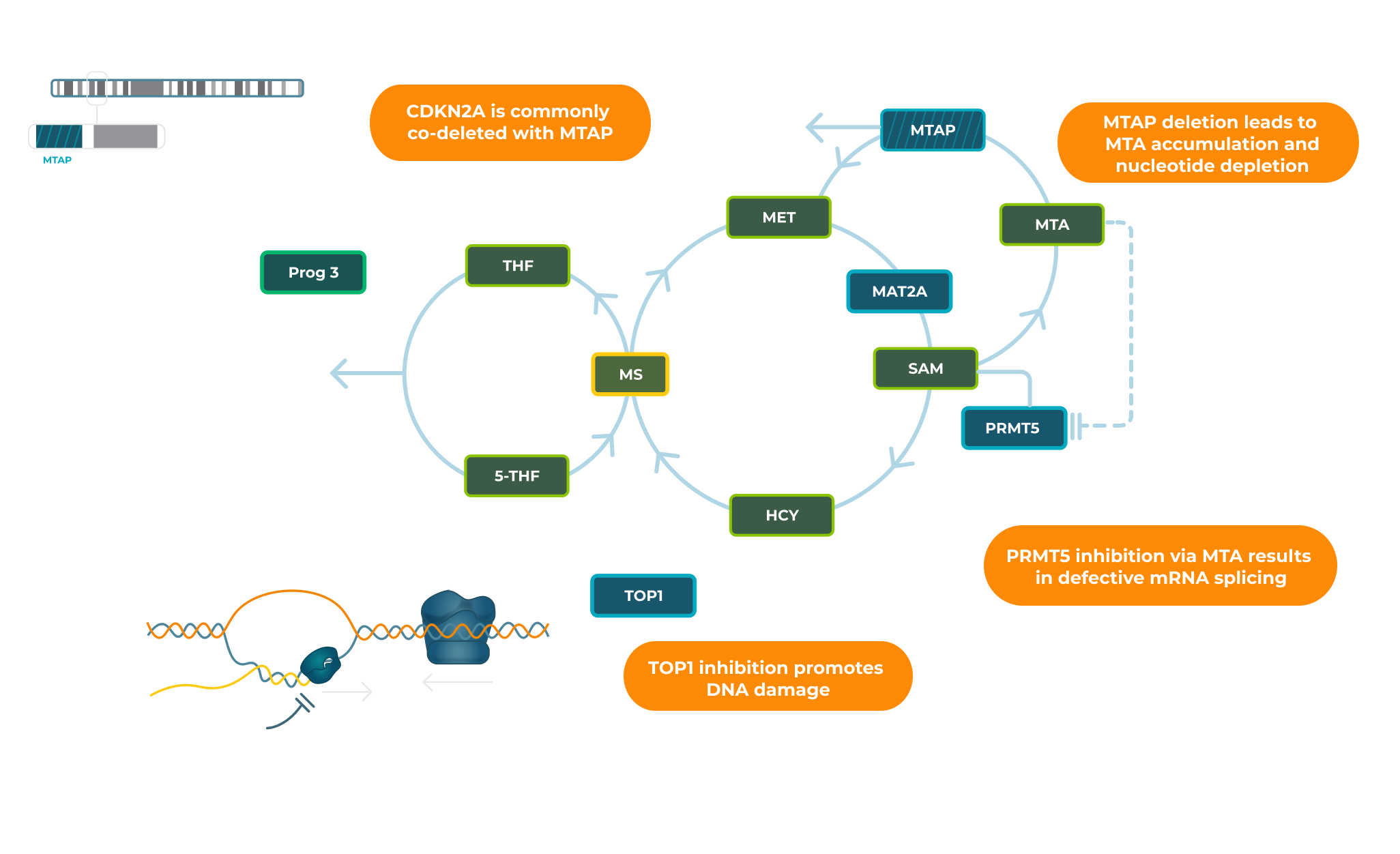
Loss of MTAP disrupts the methionine salvage pathway, leading to accumulation of methylthioadenosine (MTA) and depletion of key metabolites required for nucleotide synthesis.1,2 This results in two distinct and targetable vulnerabilities: partial inhibition of the essential methyltransferase PRMT5, which impairs mRNA splicing, and reduced capacity for nucleotide synthesis required to support DNA replication and repair.2-4
Together, these effects create a tumor-selective dependency on MAT2A, the rate-limiting enzyme for S-adenosylmethionine (SAM) production, to sustain PRMT5 activity, broader methyltransferase function, and 1-carbon metabolism.5 This dual metabolic stress establishes a unique therapeutic opportunity to selectively target MTAP-deleted tumor cells while sparing normal tissue.
A differentiated combination strategy to maximize depth and durability
IDEAYA's approach is designed to exploit this metabolic liability through coordinated inhibition of MAT2A and PRMT5, with the goal of achieving deeper and more durable responses than either approach alone.
IDE397, an allosteric MAT2A inhibitor, reduces SAM availability to shift the MTA/SAM ratio and further suppress methyltransferase activity in MTAP-deleted tumors, while preserving sufficient SAM for normal cellular function. In addition to enhancing the endogenous suppression of PRMT5, this reduction in SAM availability disrupts broader methyltransferase-dependent processes and contributes to impaired nucleotide metabolism required for tumor growth and DNA repair.6
IDE892, our MTA-cooperative PRMT5 inhibitor, is specifically engineered to preferentially bind the PRMT5–MTA complex while avoiding SAM-bound PRMT5. This enables potent and selective pathway inhibition in MTAP-deleted cells, where MTA accumulation creates a tumor-specific biochemical context.7
Together, this coordinated dual-inhibition strategy
Maximizes pathway disruption
Achieves more complete suppression of methyltransferase activity by simultaneously reducing SAM availability and directly targeting PRMT5 in an MTA-dependent manner
Targets complementary vulnerabilities
Disrupts both methyltransferase-driven processes and nucleotide metabolism required for tumor growth and DNA repair
Expands the therapeutic window
Enables selective targeting of MTAP-deleted tumors while improving the therapeutic window relative to conventional PRMT5 inhibition
By simultaneously intensifying methyltransferase disruption and impairing nucleotide metabolism, this combination can achieve sustained pathway suppression and deeper tumor responses. Importantly, dual targeting is designed to prevent adaptive resistance mechanisms observed with PRMT5 monotherapy, including epigenetic reprogramming driven by RNA and protein methylation, thus limiting tumor plasticity and blocking potential bypass pathways.8
These effects may be further amplified in combination with DNA-targeting approaches, including topoisomerase 1 (TOP1) inhibition, creating the potential for even deeper and more durable responses in MTAP-deleted tumors.
Together, this coordinated approach positions combined MAT2A and PRMT5 inhibition as a differentiated therapeutic strategy, designed to deliver both depth and durability of response for patients with MTAP-deleted cancers.
Discover IDEAYA



MTAP = Methylthioadenosine Phosphorylase, MAT2A = Methionine Adenosyltransferase 2a, MTA = Methylthioadenosine, PRMT5 = Protein Arginine Methyltransferase 5, SAM = S-adenosylmethionine, MET=methionine, HCY=homocysteine, THF= tetrahydrofolate, 5-THF= 5-methytetrahdrofolate; MS= methionine synthase